
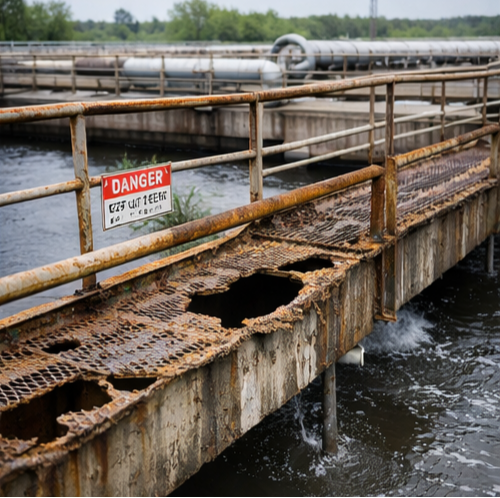
It’s not just age. It’s chemistry, biology, and operating reality outgrowing legacy materials.
When a wastewater pipe collapses, a manhole crown fails, or a wet well needs emergency rehab, the story often gets summarized as “aging infrastructure.” But in many cases, the more accurate diagnosis is material mismatch: concrete and steel are being asked to perform in environments that have become more chemically aggressive, more biologically active, and more operationally volatile than what many systems were originally designed to withstand. This is a critical issue related to wastewater infrastructure corrosion.
This isn’t a knock on legacy engineering. It’s a recognition that wastewater conditions evolve, and materials have limits. If we want resilience—not just repairs—we need to talk plainly about why failures occur, what’s changed, and why “protecting” vulnerable materials is not the same as eliminating vulnerability.
Understanding Wastewater Infrastructure Corrosion
Understanding and addressing wastewater infrastructure corrosion is essential for maintaining system integrity and performance.
The wastewater environment is not neutral—and it’s getting tougher
Inside collection systems and treatment structures, deterioration is rarely caused by a single factor. It’s the interaction of:
- Anaerobic conditions in flow that promote sulfide generation
- Headspace oxygen that enables oxidation reactions
- Persistent moisture films on walls and crowns
- Biofilms that accelerate chemical conversion and attack
- Temperature, retention time, and turbulence that influence where damage concentrates
These conditions are central to one of the most destructive mechanisms in wastewater systems: biogenic hydrogen sulfide corrosion (often discussed as biogenic sulfuric acid attack).
The real culprit: a biological-chemical chain reaction that attacks concrete and steel
The accepted mechanism is well documented: sulfate-reducing bacteria generate hydrogen sulfide (H₂S) under anaerobic conditions, and then sulfur-oxidizing bacteria convert H₂S into sulfuric acid on moist surfaces—often at the crown of pipes and in headspaces where oxygen is present. That sulfuric acid aggressively attacks cementitious materials and contributes to broader corrosion problems in wastewater assets.
This isn’t theoretical. A U.S. EPA report to Congress (based on multi-city investigation and industry survey work) identified hydrogen sulfide corrosion as a major contributor to serious system issues, including collapses and expensive rehabilitation.
Key point: this failure mode isn’t “rare.” It’s a known, repeating pattern in wastewater infrastructure worldwide—especially in places where system hydraulics, long retention times, warm temperatures, or variable loading increase sulfide generation potential. (ScienceDirect)
Why concrete is vulnerable in wastewater—and why the damage accelerates
Concrete performs beautifully in many civil applications. But in wastewater, it can be forced into a losing fight because its chemistry is fundamentally reactive under acid attack.
In biogenic sulfuric acid environments, sulfuric acid reacts with cement hydration products, forming expansive compounds and weakening the matrix—leading to softening, surface loss, and eventually cracking/spalling and structural compromise. (WJE.com)
This is why many systems experience a familiar lifecycle:
- Early-stage surface attack (often unnoticed)
- Progressive section loss and roughening
- Cracking/spalling and increased infiltration pathways
- Structural exposure (including reinforcement issues)
- Emergency repair or replacement
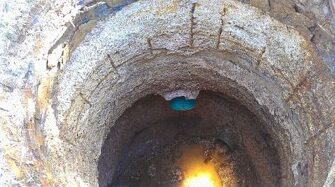
In other words: concrete doesn’t “suddenly fail.” It degrades until the remaining structure can’t tolerate load, vibration, or groundwater conditions.
Why steel isn’t the “safe alternative” in wastewater assets
Steel (and steel-reinforced systems) introduces a different vulnerability: oxidation/corrosion—especially when moisture, chlorides, and changing pH create conditions for corrosion cells and damage propagation.
Industry corrosion guidance for water and wastewater pipelines highlights how embedded steel in concrete or mortar-coated steel can require corrosion control measures—because environments vary widely and can produce serious external corrosion risk.(content.ampp.com)
And when we zoom into wastewater structures specifically, reinforcement corrosion is a known deterioration pathway in concrete assets: moisture and ions penetrate, protective films break down, steel corrodes, and the expansion forces cracking/spalling that accelerate failure.(ampp.org)
Key point: once steel corrosion starts, it often becomes a multiplier—driving cracking, increasing permeability, and making the original asset even more exposed to the wastewater environment.
“Coatings and liners” help—but they’re not a permanent answer
Many owners manage corrosion risk with coatings, liners, and rehabilitation systems. Those approaches can be valuable. But as a long-term strategy, they often create a structural dependency:
If the substrate is vulnerable, performance is only as durable as the protective layer.
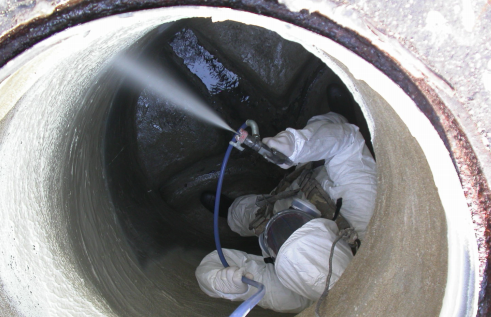
This can become a cycle:
- Apply protection
- Monitor degradation
- Repair localized failures
- Recoat/rehab
- Repeat
That’s not a criticism of coatings—it’s a recognition of a systems-level reality: in the most aggressive conditions, maintenance becomes an operating model, not an exception.
Peer-reviewed reviews of sewer corrosion and hydrogen sulfide control describe how extensive work has gone into mitigation strategies (including chemical dosing and control approaches), precisely because the mechanism is persistent and recurring. (ScienceDirect)
The uncomfortable question the industry needs to keep asking
If we understand:
- the mechanism,
- the locations most prone to attack,
- the compounding role of moisture and biofilms, and
- the life-cycle cost of recurring rehab,
then the question becomes:
Why do we keep building critical wastewater assets out of materials that require protection from the environment they’re meant to contain?
That question is not about blame. It’s about design assumptions.
Concrete and steel were the default for decades because they were available, familiar, and effective under many conditions. But wastewater has changed—and so have expectations:
- Less tolerance for spills and odor events
- Higher consequence of failures (public health + environmental + political)
- Growing pressure for uptime and continuity
- Increasing climate volatility affecting inflow and operating regimes
In that reality, “legacy materials + protection + rehab” may not be the most resilient path.
What’s next: shifting from reactive protection to material-based resilience
A more durable strategy starts by treating material selection as a primary resilience lever, not a line item after design.
In the next article, we’ll look at what it means to design out corrosion—not just manage it—and why the industry is increasingly focused on solutions that reduce dependency on coatings, liners, and recurring rehabilitation cycles by addressing the underlying failure mechanisms at the material level.

One Response
You can certainly see your expertise within the work you write.
The arena hopes for more passionate writers like you who aren’t afraid to mention how they believe.
At all times follow your heart.