
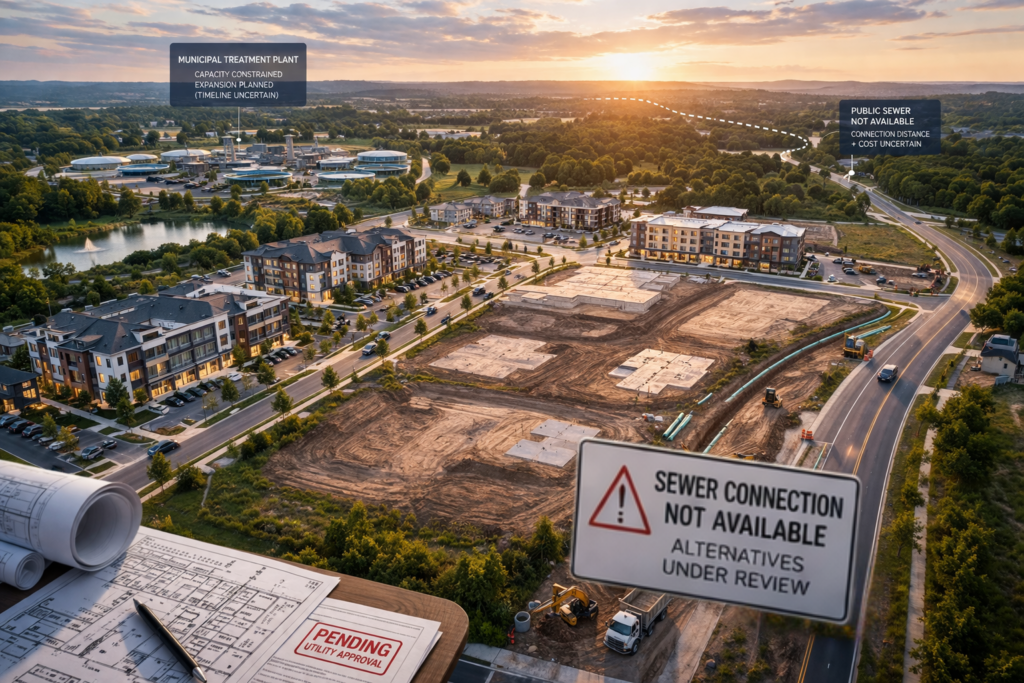
For decades, many land developers have treated water and sewer as a given.
If the site was right, the market was strong, and the deal penciled, utility service was usually expected to follow. Connection fees were paid, the local provider was engaged, and the project moved forward. But that assumption is breaking down.
Across more markets, developers are finding themselves in a very different position: the land works, the demand is real, the project is viable — but sewer is unavailable, delayed, capacity-constrained, or simply too uncertain to count on. And when that happens, wastewater stops being a background utility issue and becomes something much bigger: a development risk.
Wastewater is not optional
One of the most important realities in development is that water and wastewater are non-discretionary utilities. They are not nice-to-have services. They are required infrastructure. If wastewater cannot be managed, the project cannot move forward in any meaningful way.
That is why sewer constraints can kill momentum so quickly. A project may have location advantages, clear demand, entitled land strategy, and strong economics — but if the wastewater path is undefined, uncertainty starts to spread across the entire deal.
Suddenly, what looked like a land development problem becomes a chain reaction of unanswered questions:
- Can the project be permitted?
- Who designs the system?
- Who operates it?
- Who owns the risk?
- What happens if the approach changes later?
- What does this do to timeline, budget, and project certainty?
Those are not side questions. They go to the core of feasibility.
The biggest risk is often not technical
In many cases, the biggest barrier is not the technology itself. It is the knowledge gap around what happens next.
Developers are not truly “risking wastewater” for the first time because they lack sophistication. They are facing a problem outside the pattern they are used to. Their development model has long assumed that public sewer is simply there. When it is not, the lack of knowledge and understanding creates an undefined risk — and undefined risk is often what stalls decision-making or kills a viable project outright.
That is a critical distinction.
A project is not always abandoned because it lacks demand or because the site is wrong. Sometimes it is abandoned because the wastewater path is unfamiliar, the responsibilities are unclear, and no one has translated the issue into terms the customer can confidently act on. When public sewer is not available and decentralized wastewater is being contemplated, the lack of knowledge and understanding represents an undefined risk that is often insurmountable unless someone can quantify it in understandable terms.
Wastewater risk has multiple layers
When public sewer is not available, the risk stack expands quickly.
There is regulatory risk: permitting, inspections, approvals, and compliance requirements can delay or derail progress if they are not handled correctly. There is engineering risk: sizing, site conditions, hydraulic design, and long-term performance must be right from the start. There is operational risk: wastewater systems must perform continuously, and maintenance, monitoring, reliability, and response all matter. There is legal risk: ownership, liability, contractual responsibility, and accountability must be clearly defined. And there is the knowledge-gap risk itself: if the developer does not understand the practical path forward, hesitation can set in before the project ever gets moving.
In other words, wastewater is not just a utility line item. It is a cluster of risks that can affect schedule, cost, financing, approvals, operations, and exit strategy.
Why otherwise good projects get tabled
A lot of projects do not die with a dramatic “no.” They die with a pause.
When a team realizes sewer is not available they are unsure how to evaluate alternatives. They are unsure who would design, permit, install, operate, or stand behind a private solution. They are unsure how lenders, buyers, operators, or future stakeholders will view it. So the project gets tabled. Momentum disappears. Capital gets redirected. The opportunity fades.
In traditional development, people have often assumed public water and sewer would be available and the path would be familiar; when that assumption fails, the uncertainty can make someone abandon a project or set it aside without realizing there may still be a workable path forward.
That is the real cost of wastewater uncertainty. Not just engineering complexity. Lost timing. Lost confidence. Lost development value.
The right question is not “Can we install a system?”
That is too narrow. The better question is:
Who can define, quantify, and manage the wastewater risk in a way the project team can understand and act on?
That is the shift developers need to make. Because in many cases, the issue is not whether some form of decentralized solution exists. The issue is whether the developer has a credible, accountable partner who can help them understand what the risk actually is, how it can be managed, what responsibilities sit where, and how the project can move forward with clarity.
IINFRASTRUCTURE DYNAMICS is built for this moment
INFRASTRUCTURE DYNAMICS understands that when sewer is unavailable, the real challenge is not just treatment capacity. It is the total development burden that comes with replacing an assumed utility function.
That means helping customers think through the full picture:
- the regulatory path
- the engineering path
- the operational path
- the accountability path
- the commercial path
- and the practical decision path
It also means helping customers quantify risk in terms they can understand, so uncertainty stops being a project killer and starts becoming a solvable problem. That exact point was reinforced in your meetings: the value is not merely technical, but the ability to make the risk understandable, definable, and manageable for customers who otherwise might not know where to go.
Before walking away from a viable project
If sewer is unavailable, delayed, or uncertain, that does not automatically mean the project is dead.
But it does mean the project needs a better conversation.
Before walking away from what may still be a viable development opportunity, talk to a team that understands wastewater not only as infrastructure, but as a development risk that can be analyzed, structured, and managed.
Sewer uncertainty should not be the reason a viable project dies.
Before you table a project because sewer is unavailable, talk to INFRASTRUCTURE DYNAMICS.
