
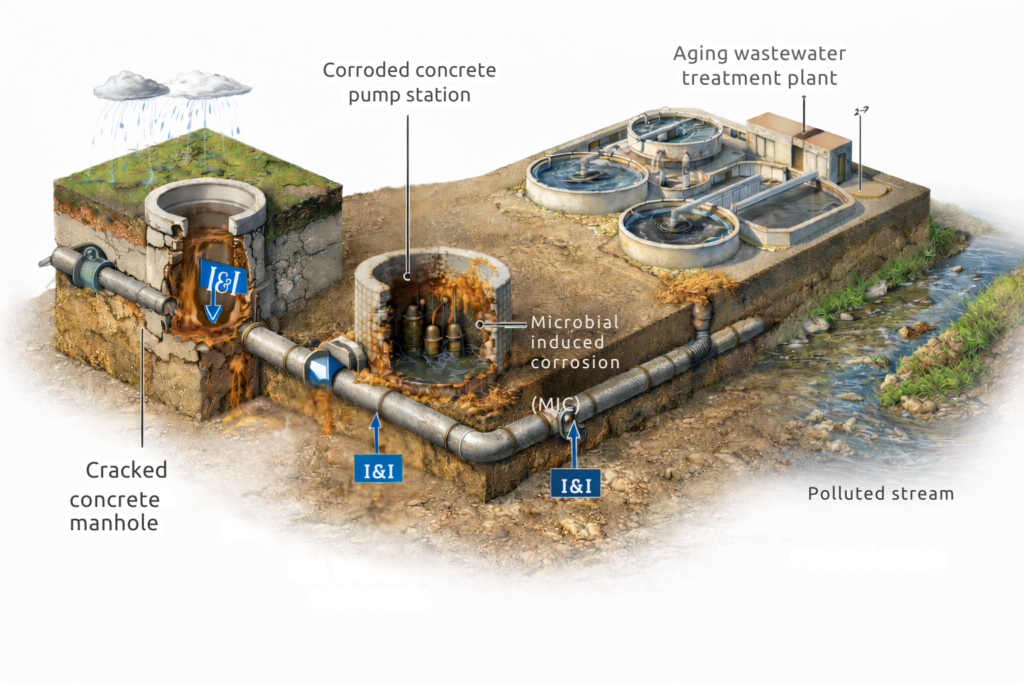
Most wastewater failures are attributed to treatment plants — odors, permit violations, energy spikes, and capacity shortfalls are often the symptoms that get the headlines. But in many cases, the treatment process is not the root cause; it’s the receiver of problems that begin much earlier in the system. To truly understand why wastewater systems struggle, we need to examine what’s happening upstream.
Collection systems are frequently treated as background infrastructure — pipes and manholes that simply move flow from point A to point B. In reality, collection systems actively shape the conditions that downstream assets must manage. Aging materials, cracked structures, leaking joints, and deteriorating manholes introduce inflow and infiltration, dilute wastewater strength, and create highly variable flow conditions. These impacts accumulate quietly long before wastewater ever reaches a pump station or treatment plant.
Pump stations, in turn, do not create upstream issues — they amplify them. Excess inflow and infiltration increases pump runtime, energy consumption, mechanical wear, and wet well turbulence. Hydraulic instability reduces control margin and operational reliability. Because pump stations concentrate civil, structural, hydraulic, mechanical, electrical, and controls risk into a single structure, upstream variability becomes a downstream failure risk.
When unstable flows and diluted influent arrive at treatment plants, operators are often asked to compensate. They must adjust aeration, recirculation, and other controls to manage conditions that the biological process was not originally designed to handle. Even robust treatment systems struggle when upstream systems continuously introduce instability.
At the root of many upstream failures are material limitations. Traditional collection structures made from concrete were not designed for permanent wet service, hydrogen sulfide exposure, microbiologically induced corrosion, or modern service-life expectations. Cracking, corrosion, and leakage are predictable outcomes — not anomalies. Rehabilitation programs may slow deterioration, but they rarely eliminate the mechanisms that cause it.
Improving wastewater performance requires a system-level perspective. Leak-tight, corrosion-resistant collection structures reduce peak flows, stabilize pump station operation, and restore biological margin at treatment plants. Addressing upstream realities is not just an infrastructure decision; it is an operational strategy that reduces cost, risk, and variability throughout the system.
About the Author
Infrastructure Dynamics engineers and manufactures integrated wastewater infrastructure systems, with a focus on materials, lifecycle performance, and system-level reliability.
