
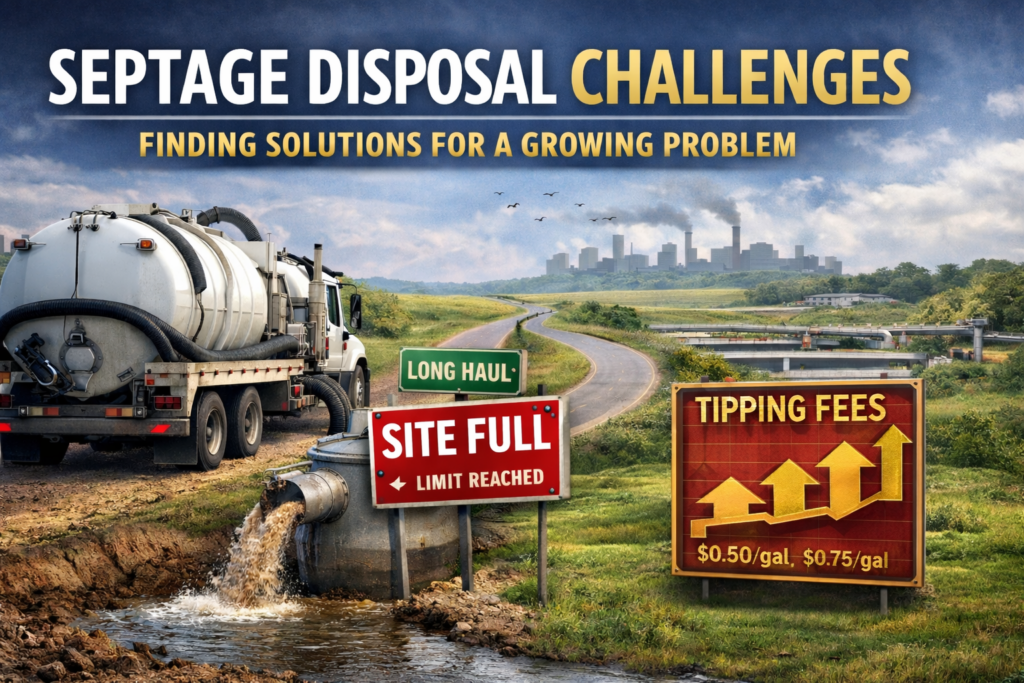
Across North America, wastewater pumpers and septic haulers are encountering a problem that is becoming harder to ignore: where does the waste go after it is pumped?
While pumping septic tanks, grease traps, and portable sanitation units is routine, disposing of the resulting waste streams is increasingly complex. Many operators report longer drive times, stricter acceptance rules, and rising disposal costs at municipal wastewater treatment plants.
Septic systems continue to serve millions of homes and businesses—particularly in rural and suburban communities. In the United States alone, more than 60 million people rely on onsite wastewater treatment systems, according to the U.S. Environmental Protection Agency. The industry is facing a structural question: how will the system scale to handle the growing volume of hauled wastewater?
The Disposal Bottleneck
Traditionally, hauled wastewater is transported to municipal wastewater treatment plants for disposal. However, these facilities were designed primarily to treat wastewater that arrives through sewer pipes—not highly concentrated septage delivered by truck.
Compared with typical municipal influent, hauled septage and sludge can contain:
- Significantly higher biological oxygen demand (BOD)
- Elevated nutrient levels, especially ammonia
- High suspended solids
- Variable contaminants from household or commercial sources
For treatment plant operators, these concentrated loads can create operational challenges, including shock loading biological systems and disrupting sludge processing (U.S. EPA “Guidance Manual for the Control of Wastes Hauled to Publicly Owned Treatment Works (POTWs)). As a result, many facilities limit the amount of hauled waste they accept—or stop accepting it entirely.
For pumpers and haulers, this translates into fewer disposal options and longer transportation distances.
The Economics of Distance
When disposal sites become scarce, transportation becomes a major cost driver.
A single truckload of septage can contain around 4,000 gallons. After dewatering, the solids may represent only a fraction of that volume, but the remaining liquid—often called filtrate or centrate—still requires treatment or disposal.
If the nearest accepting facility is several counties away, operators face:
- Increased fuel consumption
- More labor hours per job
- Reduced truck availability for revenue-generating work
- Higher tipping fees at treatment plants
For many companies, disposal logistics have become one of the most significant operational constraints in their business.
Dewatering: A Step Toward Efficiency
To reduce hauling volumes, some operators have begun using dewatering technologies such as centrifuges, belt presses, or screw presses.
Dewatering separates incoming septage into two streams:
- Solids (“cake”) that can often be transported for landfill disposal, composting, or land application.
- Filtrate, the liquid portion removed during the process.
Dewatering technologies such as centrifuges and belt presses can significantly reduce sludge volume, often increasing solids concentration from a few percent to more than 20% (Source: WEF). While dewatering dramatically reduces the volume of solids that must be transported, the filtrate still contains concentrated dissolved nutrients and organics that typically require treatment before discharge.
In many cases, this liquid stream becomes the next disposal challenge.
The Emerging Role of Decentralized Treatment
To address these constraints, the industry is increasingly exploring decentralized wastewater treatment approaches.
Rather than transporting all hauled waste to a central treatment plant, decentralized systems allow processing to occur closer to where the waste is generated. These systems may be located at:
- Septage receiving stations
- Regional processing hubs
- Waste transfer sites
- Private treatment facilities
By treating liquid streams locally, decentralized infrastructure can:
- Reduce hauling distances
- Lower transportation emissions
- Expand disposal capacity in underserved areas
- Improve operational flexibility for haulers
For rural regions without nearby municipal plants, these solutions may provide critical new infrastructure for managing wastewater.
Planning for the Future of Septage Management
Septic systems will remain an essential component of wastewater infrastructure for decades to come. In the United States alone, millions of households rely on onsite systems, particularly in areas where centralized sewer networks are not feasible.
As these systems age and population grows, the volume of septage requiring pumping and disposal will continue to increase.
Addressing this challenge will likely require a combination of approaches:
- Expanding municipal treatment plant capacity for hauled waste
- Improving septage receiving infrastructure
- Increasing adoption of dewatering technologies
- Developing decentralized treatment solutions closer to the source
For wastewater professionals, pumpers, and regulators alike, the question is no longer whether change is needed—but how to build a more resilient disposal network for the future.
