
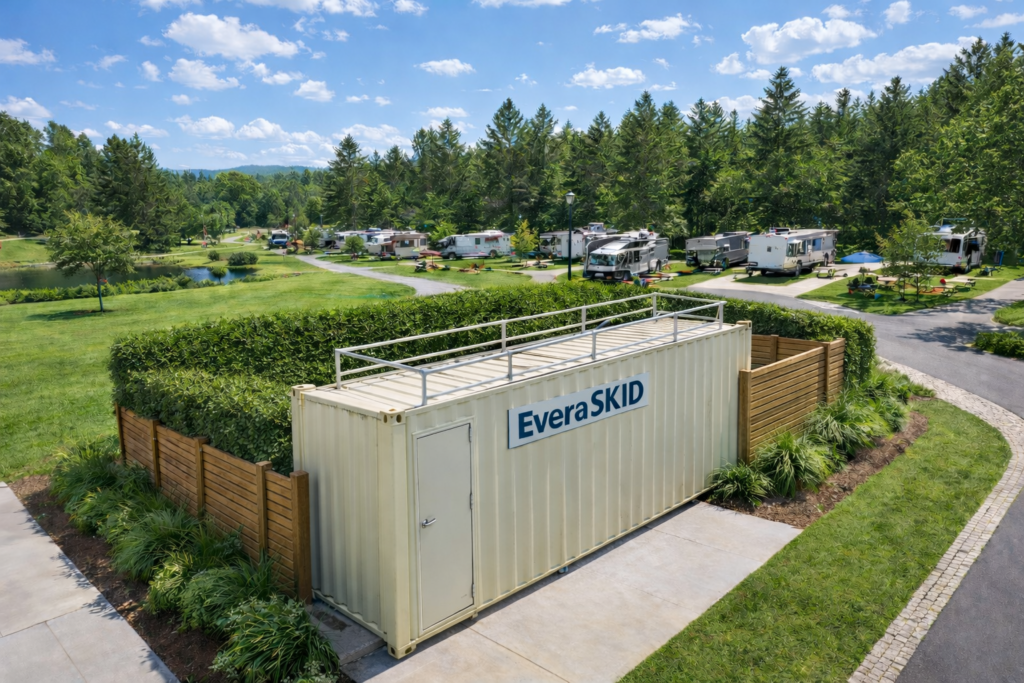
Bridging the Expertise and Capital Gap in a Constrained World
Across the United States, a quiet but critical constraint is reshaping development:
Access to water and wastewater infrastructure.
From Arizona to Texas to the Carolinas, municipalities are issuing moratoriums, delaying permits, or outright denying projects—not because of demand, but because they lack the capacity to serve them. According to the U.S. EPA, more than $600 billion in wastewater infrastructure investment is required over the next two decades, while the American Society of Civil Engineers continues to rate U.S. systems at a “D+,” highlighting the growing strain on centralized utilities.
At the same time, regulatory frameworks are becoming more stringent, not less:
- tighter nutrient limits
- stricter discharge requirements
- increased monitoring and reporting obligations
- higher standards for reliability and resilience
The result is a growing gap:
Developers need infrastructure—but increasingly lack the capital, expertise, and capacity to build and operate it.
This is where Water-as-a-Service (WaaS) is emerging as a fundamentally new model.
The Traditional Model Is Breaking Down
Historically, developers have had two options:
1. Rely on Municipal Utilities
- Limited capacity
- Long timelines
- Increasing restrictions
2. Build and Own Private Systems
- High upfront capital ($250k–$1M+)
- Requires specialized engineering expertise
- Ongoing operational burden
- Exposure to regulatory and performance risk
For large, well-capitalized organizations, this is manageable. For small to mid-sized developers, commercial operators, and decentralized projects, it is not. Industry groups such as the Water Environment Federation and the EPA have increasingly emphasized decentralized wastewater systems as a critical solution to capacity constraints.
The Hidden Problem: Expertise, Not Just Capital
While capital is often cited as the barrier, the deeper issue is capability.
Operating a wastewater treatment system is not a passive activity.
It requires:
- process engineering knowledge
- regulatory compliance management
- routine monitoring and reporting
- preventative and corrective maintenance
- contingency planning for system failures
And increasingly:
- adaptation to evolving regulatory standards
- nutrient management strategies
- system upgrades over time
Most developers—and many end users—are not equipped to manage this.
Nor should they be.
Enter WaaS: Infrastructure Delivered as a Service
Water-as-a-Service (WaaS) fundamentally changes the model.
Instead of:
👉 designing, financing, building, and operating a utility
The customer:
👉 subscribes to a fully managed infrastructure service
What WaaS Includes
A true WaaS model provides:
- Design & Engineering – tailored to site-specific needs
- Capital Deployment – no upfront cost to the customer
- Construction & Installation – modular, scalable systems
- Ownership of the Asset – retained by the provider
- Operations & Maintenance – fully managed
- Regulatory Compliance – reporting, permitting, monitoring
- Lifecycle Management – including future upgrades and replacements
The customer pays a predictable monthly fee for performance—not equipment.
Solving the Capital Gap
For smaller developments, capital constraints are often decisive.
WaaS eliminates the need for:
- large upfront capital expenditures
- construction financing tied to utilities
- balance sheet allocation to non-core infrastructure
This enables:
- faster project initiation
- improved capital efficiency
- reallocation of capital to core business activities
Solving the Expertise Gap
Equally important, WaaS eliminates the need for in-house expertise.
The provider assumes responsibility for:
- system performance
- regulatory compliance
- operational continuity
- technical troubleshooting
This transforms a complex, high-risk function into:
a managed utility service with defined outcomes
Risk Transfer: The Most Undervalued Benefit
One of the most misunderstood aspects of WaaS is risk transfer.
Under traditional ownership, the customer bears:
- system failure risk
- compliance violations
- evolving regulatory requirements
- replacement and upgrade costs
- performance shortfalls
Under WaaS:
👉 These risks shift to the provider.
This is particularly important in an environment where:
- regulatory requirements are tightening
- environmental scrutiny is increasing
- penalties for non-compliance are significant
Addressing the “Cost” Question
It is true that, on paper, WaaS may appear more expensive than ownership.
But this comparison is often incomplete.
Ownership models typically underestimate or exclude:
- operational labor
- downtime risk
- compliance burden
- system replacement costs
- engineering oversight
- regulatory exposure
When these factors are properly accounted for, the gap narrows significantly—and in many cases, disappears.
More importantly, WaaS offers something ownership cannot:
certainty, simplicity, and risk reduction
A Model Built for the Future of Development
As infrastructure constraints intensify, WaaS is particularly well suited for:
- decentralized developments
- industrial and high-strength wastewater applications
- rural or underserved areas
- projects facing utility capacity limitations
- developers without in-house engineering teams
It also aligns with broader trends:
- modular infrastructure
- distributed systems
- resource reuse (e.g., irrigation, water recycling)
- sustainability-driven design
This approach mirrors the rise of “as-a-service” models in energy and infrastructure, where companies like Schneider Electric and ENGIE deliver outcomes rather than assets.
From Infrastructure Burden to Utility Service
At its core, WaaS represents a shift in mindset.
From:
👉 “We need to build and manage a utility”
To:
👉 “We need reliable water and wastewater service”
This distinction is critical.
Because developers, manufacturers, and operators are not in the business of running utilities.
They are in the business of:
- building communities
- producing goods
- delivering services
WaaS allows them to focus on those core activities—while a specialized provider handles the rest.
Conclusion
Water and wastewater infrastructure is no longer a background consideration.
It is a primary constraint on growth.
As institutional capital increasingly flows into water infrastructure and regulatory pressures continue to intensify, new delivery models like WaaS are poised to play a central role in enabling future development.
Water-as-a-Service offers a compelling alternative:
- removing upfront capital barriers
- eliminating operational complexity
- transferring long-term risk
- accelerating project timelines
In doing so, it transforms infrastructure from a bottleneck into an enabler.
