
Municipal Utilities • North America

Corrosion-Resistant Wastewater Infrastructure

A practical guide for designing long-life systems in corrosive wastewater environments

Corrosion drives lifecycle cost, safety risk, and premature replacement across wastewater facilities. This guide breaks down the corrosion challenge, design requirements, modular approaches, and how utilities evaluate long-term solutions.

corrosion-resistant wastewater infrastructure

The corrosion challenge in municipal wastewater systems

Wastewater environments are inherently aggressive. Biological processes generate hydrogen sulfide (H₂S), which can oxidize to sulfuric acid on exposed surfaces. High humidity and limited ventilation allow corrosive gases and condensate to persist—especially in enclosed structures.

Corrosion is often most severe where moisture, turbulence, and gas exposure combine. Over time, degradation can affect serviceability, safety, and structural reliability—particularly in assets expected to last decades.

High-risk locations

  • Headworks and screening facilities
  • Wet wells and pump stations
  • Odor control systems
  • Channels, enclosures, and confined spaces

Why corrosion drives lifecycle cost and operational risk

Corrosion is more than a surface issue. For municipal utilities, the long-term impacts frequently show up as increasing maintenance burden, safety risk for O&M staff, and difficult retrofits in live facilities.

Maintenance escalation

Access constraints and operational continuity can multiply repair costs over time.

Safety & reliability

Degraded assets increase confined-space risk and raise the probability of unplanned outages.

Capital plan pressure

Premature replacement shifts projects forward and compresses multi-year budgets.

Limitations of traditional materials in wastewater applications

Concrete

Susceptible to chemical attack; coatings can help but depend on prep quality and long-term inspection discipline.

Steel

Requires corrosion protection and maintenance—often challenging in confined or hard-to-access spaces.

Field-applied liners

Can reduce exposure but introduce variability in installation quality and long-term adhesion.

Engineering takeaway: Corrosion management improves when systems rely less on field-applied protection and more on inherently resistant design choices.

Design requirements for corrosion-resistant wastewater infrastructure

  • Inherent resistance to corrosive gases and liquids
  • Predictable long-term structural performance
  • Compatibility with modular/prefabricated delivery
  • Minimal reliance on coatings/linings for durability
  • Ease of inspection, cleaning, and maintenance
  • Constructability within live municipal facilities

Role of corrosion-resistant materials in modern municipal systems

Materials with inherent corrosion resistance can reduce lifecycle uncertainty by resisting chemical attack throughout service life.

See fabrication approach

How corrosion-resistant wastewater systems are fabricated for quality and repeatability.

Explore manufacturing

Modular and prefabricated approaches for municipal utilities

  • Shorter on-site construction windows
  • Improved quality control through controlled fabrication
  • Reduced confined-space exposure
  • Less disruption to active operations

Best-fit scenarios

Retrofits, tight footprints, constrained schedules, and limited shutdown windows.

Applications across municipal wastewater facilities

Corrosion-resistant infrastructure is applied throughout municipal wastewater facilities where hydrogen sulfide exposure, moisture, and limited access accelerate material degradation. Application-specific requirements vary by process, operating conditions, and lifecycle expectations, making system-level design considerations critical.

Pump Stations and Wetwells

Pump stations and wet wells combine confined spaces with cyclic wet/dry exposure and elevated corrosive gas concentrations. Over time, these conditions can compromise structural integrity, coatings, access systems, and safety features.

Corrosion-resistant pump station structures are commonly used to reduce lifecycle maintenance, improve confined-space safety, and support long-term reliability in both new construction and retrofit projects.

Modular Wastewater Pump Stations

Modular Wastewater Treatment Systems

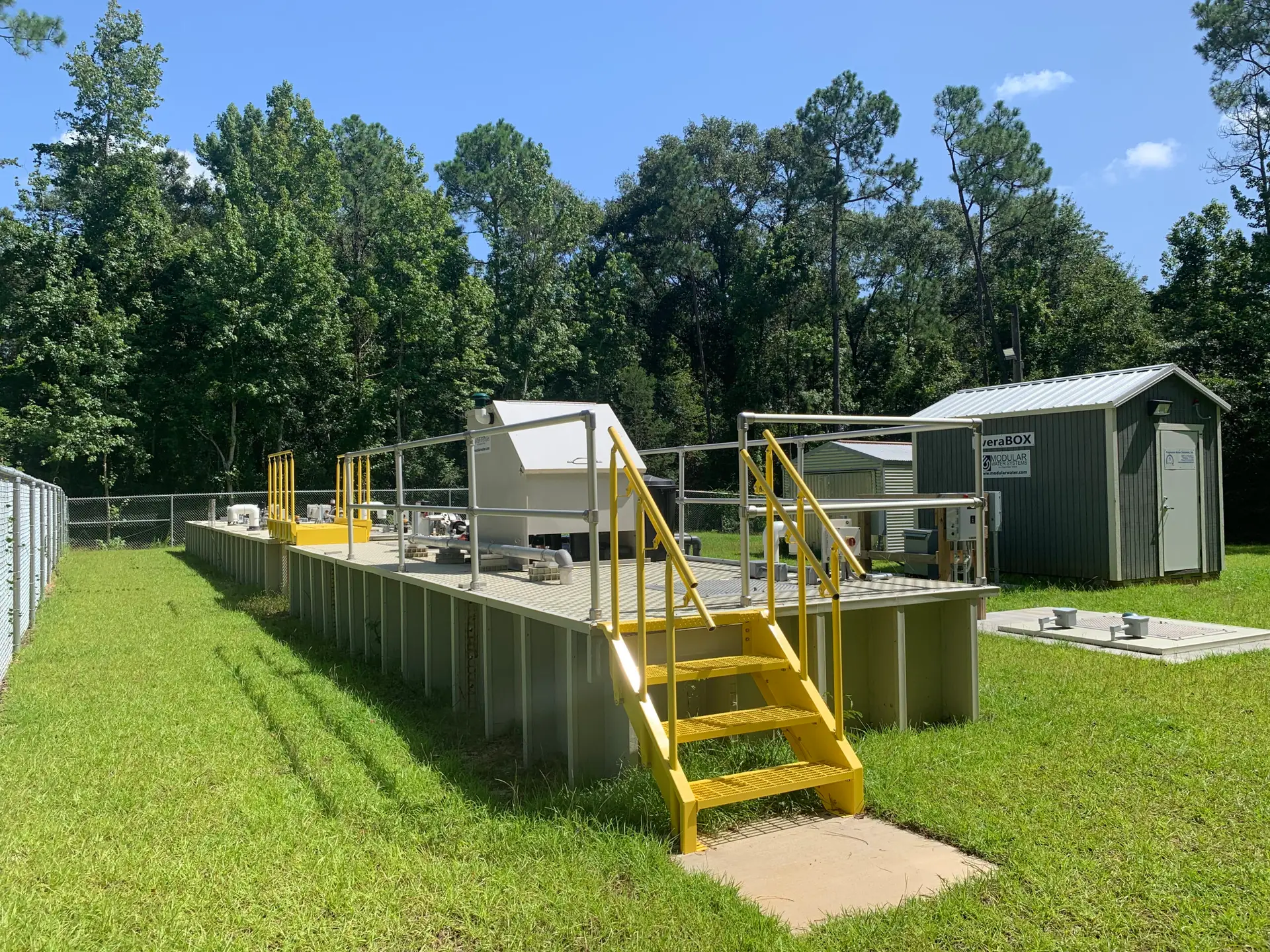
Packaged and modular wastewater treatment systems concentrate multiple processes within compact footprints, often enclosed or partially enclosed. This can increase exposure to corrosive gases and condensate, particularly in decentralized or satellite treatment applications.

Corrosion-resistant modular treatment systems support predictable long-term performance while enabling prefabrication, rapid deployment, and consistent quality control.

Modular Wastewater Treatment Solutions

Sanitary Sewer Manholes

Manholes and access structures are continuously exposed to wastewater gases and moisture, often with limited opportunities for inspection or rehabilitation once installed. Corrosion-related degradation can create long-term maintenance and safety challenges.

Corrosion-resistant manholes are used to extend service life, reduce rehabilitation frequency, and improve safety during inspection and maintenance activities in aggressive collection system environments.

Corrosion-Resistant Manholes

Headworks and Equipment Enclosures

Headworks facilities and equipment enclosures are often among the most corrosive environments in a wastewater treatment plant. High H₂S concentrations, continuous moisture, and turbulence can rapidly degrade conventional materials and protective coatings.

Corrosion-resistant headworks structures and equipment enclosures help protect mechanical and electrical systems while supporting long-term durability, access for maintenance, and safer operating conditions.

Dedicated headworks/enclosure systems are typically integrated as part of broader corrosion-resistant infrastructure solutions.

Together, these applications illustrate how corrosion-resistant systems are deployed across municipal wastewater facilities to address durability, safety, and lifecycle performance challenges.

How municipal utilities evaluate corrosion-resistant solutions

  1. Define exposure (gas/liquid contact, humidity, ventilation, temperature).
  2. Set requirements (service life, inspection needs, structural demands).
  3. Assess constructability (access, shutdown windows, bypass, safety).
  4. Compare lifecycle risk (maintenance frequency, repair logistics, uncertainty).
  5. Pilot or phase where appropriate.

Frequently asked questions

Why does corrosion progress faster in wastewater than stormwater?

Wastewater commonly generates corrosive gases (including H₂S) through biological processes; enclosed humidity and condensate accelerate degradation.

When does prefabrication make sense for municipal wastewater projects?

When access is limited, schedules are constrained, or work must occur in live facilities with short shutdown windows and costly bypassing.

How do utilities justify corrosion-resistant choices internally?

Many use a lifecycle and risk lens: maintenance burden, safety, inspection practicality, and service continuity—not only first cost.

A next-generation engineering and manufacturing company delivering innovative equipment and infrastructure products for the water, wastewater, and energy storage utility markets.

© 2026 Infrastructure Dynamics. All rights reserved.