
Water scarcity is no longer a future risk—it is a present and growing constraint shaping how communities plan, operate, and invest in infrastructure. Across the American West, declining reservoir levels, hydrologic uncertainty, and rising demand are forcing utilities and decision-makers to confront a fundamental question: Are our water systems designed for the conditions we now face?
The ongoing crisis in the Colorado River Basin illustrates a broader challenge. Many of the systems that underpin water supply, treatment, and reuse were built around historical assumptions that no longer hold. Addressing scarcity will require more than incremental conservation measures. It will require rethinking how water systems function as integrated, adaptive systems.
The Limits of Traditional Water System Design
For decades, centralized water and wastewater systems have provided reliable service and supported growth. Large reservoirs, long-distance conveyance, and centralized treatment facilities became the backbone of water management in arid and semi-arid regions.
Today, those systems face increasing strain:
- Reduced snowpack and higher temperatures are limiting reliable inflows
- Long conveyance systems increase energy use and vulnerability
- Wastewater is treated to high standards but often discharged rather than reused
- Expanding centralized infrastructure requires significant capital investment
- System flexibility is limited during droughts or peak demand periods
Conservation remains a critical tool, but conservation alone cannot fully address long-term supply imbalances. To build resilience, utilities must also expand how they think about water sources and system design.
Decentralized Wastewater Treatment as a Systems Strategy
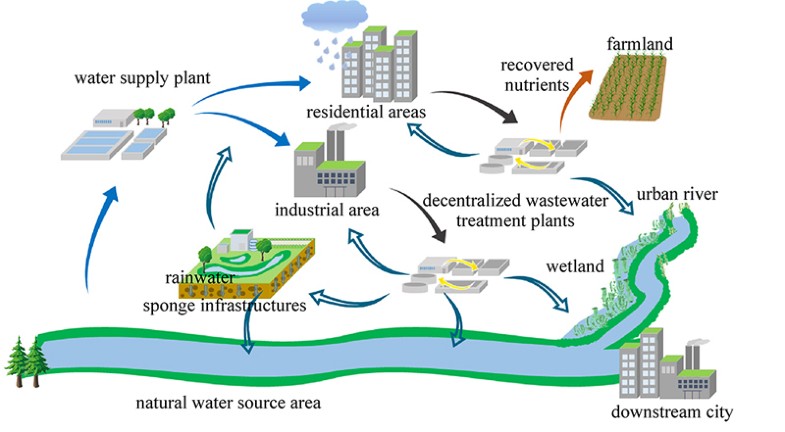
Decentralized wastewater treatment offers a complementary approach to traditional centralized systems. Rather than collecting all wastewater at a single facility, decentralized or satellite systems treat water closer to where it is generated—at the neighborhood, campus, or district scale.
When paired with water reuse and reclamation, decentralized systems enable fit-for-purpose reuse, supplying treated water for non-potable demands such as irrigation, industrial processes, cooling, or toilet flushing. This reduces demand on potable supplies while improving overall system efficiency.
From a planning and operations perspective, decentralized systems can:
- Reduce peak loads on centralized treatment facilities
- Defer or downsize major capital expansion projects
- Improve operational flexibility and drought resilience
- Support development without proportionally increasing system demand
- Add redundancy that enhances overall system reliability
In water-scarce regions, reuse represents a locally controlled supply that is less dependent on hydrologic variability.
Unlocking the Full Potential of Water Reuse
Despite advances in treatment technology and evolving regulatory frameworks, water reuse remains underutilized in many parts of the West. Large volumes of treated wastewater continue to leave service areas as discharge, even as freshwater supplies become increasingly constrained.
Expanding reuse—particularly through decentralized or hybrid system approaches—allows utilities to:
- Retain water within their service areas
- Align treatment levels with specific end uses
- Reduce reliance on imported or overallocated sources
- Phase infrastructure investments over time
- Integrate reuse into long-term sustainability and resilience planning
Importantly, decentralized reuse systems can be scaled incrementally, allowing utilities to adapt as conditions, regulations, and community needs evolve.
Planning for a Drier, Less Certain Future
Water scarcity should be understood not as a temporary disruption, but as a defining condition that will shape infrastructure decisions for decades. Addressing it effectively requires a shift toward integrated system planning—one that considers how centralized and decentralized components work together.
Key questions for utilities and planners include:
- Where does localized reuse provide the greatest operational benefit?
- How can decentralized systems complement existing infrastructure?
- How do near-term investments support long-term resilience?
- How can policy, planning, and engineering align under increasing uncertainty?
Treating water scarcity as a systems problem opens the door to solutions that are more adaptive, resilient, and economically sustainable.
Looking Ahead
At INFRASTRUCTURE DYNAMICS, we focus on understanding how water systems function as part of broader infrastructure, land-use, and community systems. Designing for resilience means acknowledging uncertainty and building flexibility into the way water is treated, reused, and managed.
Decentralized wastewater treatment and water reuse are not standalone solutions, but they are increasingly important components of a diversified, resilient water strategy—particularly in regions facing long-term scarcity.
As communities, utilities, and policymakers navigate the challenges ahead, systems-level thinking will be essential to ensuring reliable, sustainable water service in a changing climate.
About the Author
Michael Gallagher, PE is Chief Operating Office and General Manager at INFRASTRUCTURE DYNAMICS, providing executive leadership in the design and manufacture of engineered water and infrastructure solutions.
